Tides You Can See
Scanning through notes from books I’ve read, as the new year barrels forward I’m looking for insights on time.
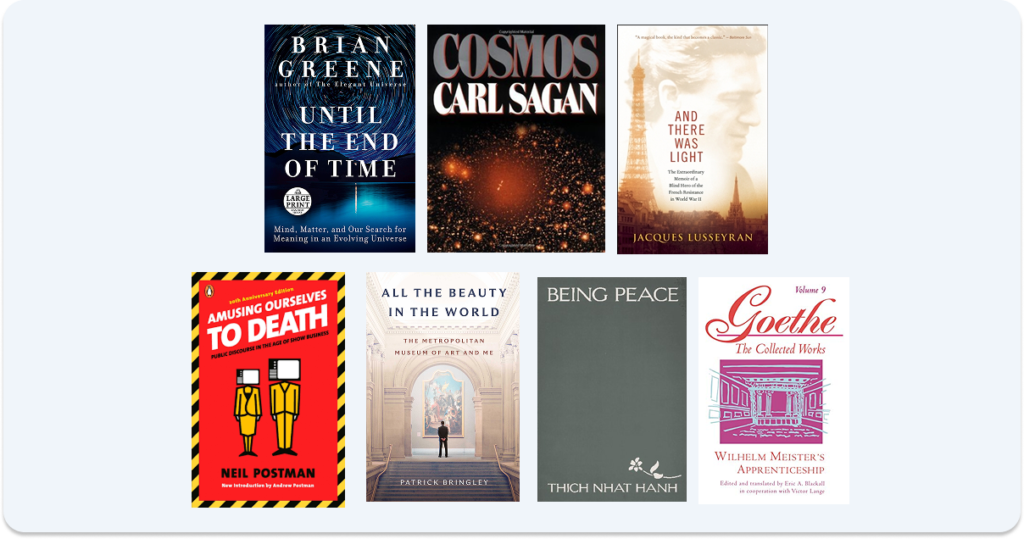
My first find emphasizes the giant infinity of all time and the smallness of our piece of it. From Brian Greene’s Until The End of Time, “we emerge from laws that, as far as we can tell, are timeless…and yet we persistently seek meaning and purpose.”
It’s hard to pass a milestone like New Years without taking inventory.
It’s not easy to swallow the most obvious answer. The one shared in Cosmos by Carl Sagan, that “compared to a star, a human being is a tiny flash, one of a billion brief lives flickering tenuously.”
We made the countdown last night.
10, 9, 8, 7, 6…
The clock turning an hour just like any other. Neil Postman has great musing on the clock in his ominously prophetic Amusing Ourselves To Death. He starts by quoting Lewis Mumford, an American historian and philosopher of technology and cities:
“The clock,” Mumford writes, “is a piece of power machinery whose ‘product’ is seconds and minutes.”
And Postman continues on, “in manufacturing such a product the clock has the effect of disassociating time from human events and thus nourishes the belief in an independent world of mathematically measurable sequences. Moment to moment, it turns out, is not God’s conception, or nature’s. It is man conversing with himself about and through a piece of machinery he created.”
Time.
Old English tima, of Germanic origin; related to tide, which it superseded in temporal senses. The earliest of the current verb senses (dated from late Middle English) is “do (something) at a particular moment.”
Tides.
Tides you can see.
I love it when things can feel so overwhelming on the surface, but then fall completely apart into total sense.
It reminds me of a passage from Patrick Bringley’s All The Beauty in the World, observing “The Egyptians did not think about time as we do…its essence was the circle, not the arrow…everything constantly in flux but nothing ever really changing.”
In so many ways, then, January 1st is just a delusion. Maybe instead, the moment of true rejuvenation and new beginnings should sprout in Spring, when everything wakes up from the cold and blooms anew. Or maybe for young families, it’s the start of a new school year, when the pencil cases are clean and the pages in all books have straight, crisp corners. Or like Helene Hanff observes in Letter From New York, it’s something more urban, like “in October, when New York is suddenly alive and jumping with new Broadway shows and new books in the bookstores and a new Philharmonic season and new restaurants opening and everybody moves quickly, everybody makes plans, there are new worlds to conquer and anything can happen.”
Too many thens and nows, and endings or beginnings to track.
Jacques Lusseyran, a WWII French Resistance fighter, has nice instructions in his powerful memoir And There Was Light, advising to “never think that an hour earlier you were cold and that an hour later you will be cold again. Just enjoy.”
Reliably, this rhymes with the most sage perspective I could find. It’s from Goethe. He writes in Wilhelm Meister’s Apprenticeship, “Since we can’t pursue time that is passed, let us at least celebrate it joyfully and gracefully while it is passing us by.”
…5, 4, 3…
Thich Nhat Hanh, from Being Peace, “each second, each minute…can be like this.”
…2, 1…
Happy New Year.
Books referenced: